
Agricultural Input Subsidies in Mozambique: Raising the Subsidy on the Large Package
Introduction
Christian, Glover, Kondylis, Loeser, Ruzzante, and Zwager (2026) study how the shape of agricultural input subsidies (how the subsidy rate varies with the quantity of inputs a farmer buys) affects which farmers use inputs and how much they produce. The paper’s setting is the eVoucher program of the UN Food and Agriculture Organization (FAO) in 10 districts of northern Mozambique, under which registered farmers redeem an electronic voucher at agrodealers for improved seeds, fertilizer, tools, and pesticides, choosing among three packages (Small, Medium, and Large) whose subsidy rate falls with size. Under the standard “Decreasing” schedule, a farmer pays 400 Mozambican meticais (MZN) for 4,000 MZN of inputs (a 90 percent subsidy), 1,200 MZN for 6,500 MZN (82 percent), or 4,200 MZN for 11,000 MZN (62 percent).
For the 2023 primary season, the paper randomly assigned 1,280 farmers in 187 villages to four schedules. The paper studies three alternatives to the standard “Decreasing” subsidy schedule:
- “Sharply Decreasing” cuts the prices of the Small and Medium packages by 300 MZN (the rate falls even more steeply)
- “Uniform” cuts the price of the Large package by 2,600 MZN to 1,600 MZN (an 85 percent subsidy, so that subsidy rates are roughly uniform across sizes)
- “High & Decreasing” combines both cuts, so the rates are higher overall but still fall with size
Using voucher records and household surveys, the paper finds that moving to a Uniform schedule raised redemption of the Large package by 19.5 percentage points and agricultural production by 36 percent (6,770 MZN per farmer), with the gains concentrated among farmers who row plant (sow in rows, a skill-intensive practice that complements fertilizer). The paper finds that the Uniform schedule is the most productive of the four schedules but, because farmers who redeem the Large package are considerably richer, also the most regressive.
This entry reports the MVPF of moving from the standard Decreasing schedule to a Uniform schedule. The paper also estimates the MVPF of the two other treatment arms: moving to a Sharply Decreasing schedule, which cuts only the prices of the Small and Medium packages, and moving to a High & Decreasing schedule, which cuts the prices of all three packages.
MVPF = 1.3
Net Cost
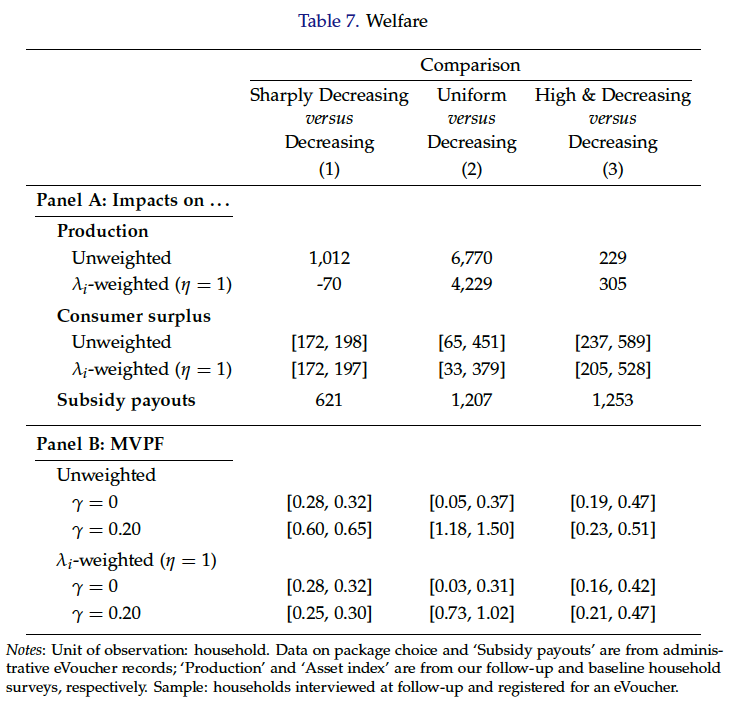
The net cost is the increase in subsidy payouts, the money FAO pays agrodealers to cover the value of redeemed inputs beyond what farmers pay themselves. The paper estimates that Uniform raised payouts by 1,207 MZN per registered farmer, relative to an average of 2,533 MZN under Decreasing (100 MZN is about 1.5 USD).
Only a small part of this cost is mechanical: just 2.5 percent of farmers redeemed the Large package under Decreasing, so the price cut for them costs 0.025 × 2,600 = 65 MZN per farmer. The rest comes from farmers induced to take the Large package, with its 9,400 MZN subsidy, instead of Medium (5,300 MZN), Small (3,600 MZN), or not redeeming their voucher at all.
Net cost is the change in subsidy payouts alone: it includes no fiscal externality from the farmers’ production gains, as the effective tax and transfer rate on that additional income is effectively zero.
Willingness to Pay
The paper estimates willingness to pay as the change in consumer surplus and impacts on productivity.
Consumer surplus: The paper bounds farmers’ willingness to pay for the price cut by revealed preference. The lower bound credits the 2,600 MZN cut only to the 2.5 percent of farmers who took the Large package under the Decreasing schedule: 0.025 × 2,600 = 65 MZN. The upper bound, 451 MZN, uses the cross-randomization: a farmer who takes the Large package under the Uniform schedule but not under the High & Decreasing schedule (where Small and Medium are also cheaper) gains at most 300 MZN, and one who takes it under both gains at most 2,600 MZN.
Productive impacts: The paper argues that farmers underestimate the returns to inputs and so do not fully weigh production gains when choosing a package. The planner places a direct weight, γ, on the change in production. γ = 0.2 is the product of a discount factor of 0.6 (which the paper says implies an 8 percent required monthly return over a crop cycle of about six months) and a bias of one third. The bias comes from learning: the Uniform schedule’s effect on redemption of the Large package persisted in the two years after the extra subsidy ended, from which the paper estimates that Uniform raised willingness to pay by approximately one half, evidence, in the paper’s reading, that farmers underestimate the returns to inputs by at least one third. Applied to the 6,770 MZN production gain, this is 0.2 × 6,770 = 1,354 MZN.
Total willingness to pay is therefore between 65 + 1,354 = 1,419 MZN and 451 + 1,354 = 1,805 MZN, with a midpoint of 1,612 MZN. The range reflects partial identification (as opposed to a confidence interval), as the experiment bounds consumer surplus rather than pinning it down.
MVPF Summary
Dividing by the net cost gives an MVPF between 1,419 / 1,207 = 1.18 and 1,805 / 1,207 = 1.50, the unweighted bounds the paper reports in its Table 7. The 1.34 reported here is the midpoint of these partial-identification bounds.
On the same unweighted basis with γ = 0.2, Table 7 puts the other two schedules well below Uniform: Sharply Decreasing at 0.60 to 0.65 (net cost 621 MZN) and High & Decreasing at 0.23 to 0.51 (net cost 1,253 MZN). Without the weight on productive impacts (γ = 0), Uniform falls to 0.05 to 0.37, and Sharply Decreasing, at 0.28 to 0.32, has the highest lower bound. The paper’s preferred specification also weights benefits by social marginal utility, with an inequality aversion of 1; because Uniform’s benefits are concentrated among wealthier farmers, this lowers its MVPF to 0.73 to 1.02. In the paper’s analysis, Uniform remains the best choice at every level of inequality aversion the paper considers, as long as productive impacts get at least half of the paper’s preferred weight (γ = 0.1).
References
Christian, Paul, Steven Glover, Florence Kondylis, John Loeser, Matteo Ruzzante, and Astrid Zwager (2026). “Reshaping Agricultural Subsidies.” Working Paper. Available at: https://matteo-ruzzante.com/assets/pdf/cgklrz.pdf
Policy Features
- Category
- Taxes
- Sub-Category
- Firm Taxes/Subsidies
- Beneficiary Type(s)
- Adults, Firms
- Country of Implementation
- Mozambique
- Year of Implementation
- 2023
- Empirical Method
- RCT
- Research Type
- Primary
- Peer Reviewed
- No
- MVPF Publication Link
- matteo-ruzzante.com/assets/pdf/cgklrz.pdf