
Agricultural Input Subsidies in Mozambique: Raising Subsidies on Small and Medium Packages
Introduction
Christian, Glover, Kondylis, Loeser, Ruzzante, and Zwager (2026) study how the shape of agricultural input subsidies (how the subsidy rate varies with the quantity of inputs a farmer buys) affects which farmers use inputs and how much they produce. The paper’s setting is the eVoucher program of the UN Food and Agriculture Organization (FAO) in 10 districts of northern Mozambique, under which registered farmers redeem an electronic voucher at agrodealers for improved seeds, fertilizer, tools, and pesticides, choosing among three packages (Small, Medium, and Large) whose subsidy rate falls with size. Under the standard “Decreasing” schedule, a farmer pays 400 Mozambican meticais (MZN) for 4,000 MZN of inputs (a 90 percent subsidy), 1,200 MZN for 6,500 MZN (82 percent), or 4,200 MZN for 11,000 MZN (62 percent).
For the 2023 primary season, the paper randomly assigned 1,280 farmers in 187 villages to four schedules. The paper studies three alternatives to the standard “Decreasing” subsidy schedule:
- “Sharply Decreasing” cuts the prices of the Small and Medium packages by 300 MZN (the rate falls even more steeply)
- “Uniform” cuts the price of the Large package by 2,600 MZN to 1,600 MZN (an 85 percent subsidy, so that subsidy rates are roughly uniform across sizes)
- “High & Decreasing” combines both cuts, so the rates are higher overall but still fall with size
Using voucher records and household surveys, the paper finds that moving to a Sharply Decreasing schedule raised redemption of the Small and Medium packages by 9.4 percentage points, mostly by drawing in farmers who would otherwise not have redeemed their voucher, and increased the value of improved seeds redeemed but not of fertilizer. Its estimated effect on agricultural production, 1,012 MZN per farmer, is not statistically significant, which the paper reads as a sign that the farmers it draws in gain less from additional inputs than those drawn in by moving to a Uniform schedule. Because the farmers who choose the smaller packages are poorer than those who take Large, the extra money under Sharply Decreasing goes to less well-off farmers than Uniform’s does.
This entry reports the MVPF of moving from the standard Decreasing schedule to a Sharply Decreasing schedule. The paper also estimates the MVPF of the two other treatment arms: moving to a Uniform schedule, which cuts only the price of the Large package, and moving to a High & Decreasing schedule, which cuts the prices of all three packages.
MVPF = 0.6
Net Cost
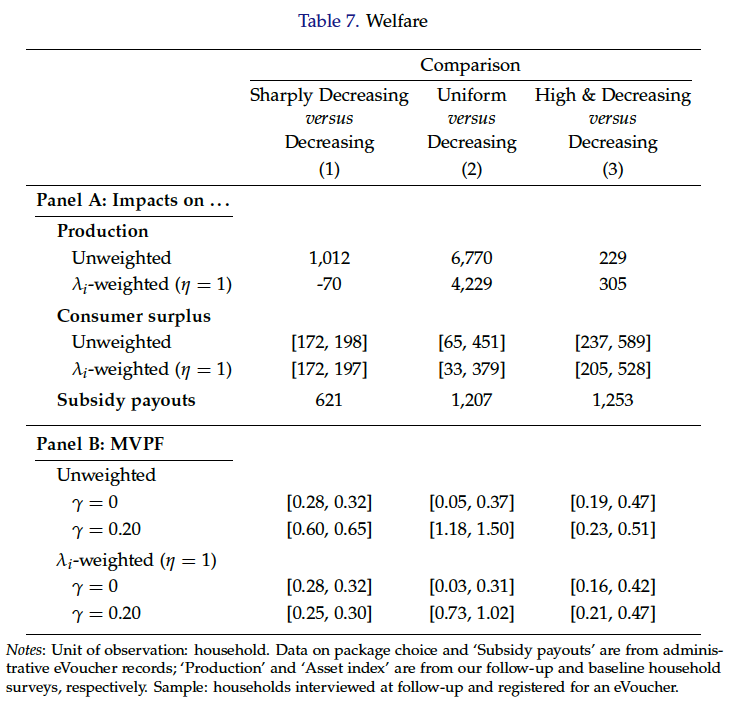
The net cost is the increase in subsidy payouts, the money FAO pays agrodealers to cover the value of redeemed inputs beyond what farmers pay themselves. The paper estimates that Sharply Decreasing raised payouts by 621 MZN per registered farmer, relative to an average of 2,533 MZN under Decreasing (100 MZN is about 1.5 USD).
Part of this cost is mechanical: the farmers who would have redeemed the Small or Medium package anyway, 57.5 percent of registered farmers, each receive an extra 300 MZN, about 172 MZN per registered farmer. The rest comes mainly from the 7.8 percentage points of farmers induced to redeem a voucher they would otherwise have left unused, who now receive a subsidy of 3,900 MZN on the Small package or 5,600 MZN on Medium.
Net cost is the change in subsidy payouts alone: it includes no fiscal externality from any change in the farmers’ production, as the effective tax and transfer rate on that income is effectively zero.
Willingness to Pay
The paper estimates willingness to pay as the change in consumer surplus and impacts on productivity.
Consumer surplus: The paper bounds farmers’ willingness to pay for the price cuts by revealed preference. The lower bound credits the 300 MZN cut only to farmers who took the Small or Medium package under Decreasing: 172 MZN. The upper bound credits it to every farmer who takes one of these packages under Sharply Decreasing: 198 MZN. The bounds are close together because the cut is small, so even a farmer it induces to switch packages gains at most 300 MZN.
Productive impacts: The paper argues that farmers underestimate the returns to inputs and so do not fully weigh production gains when choosing a package; the planner therefore places a direct weight, γ, on the change in production. γ = 0.2 is the product of a discount factor of 0.6 (by the paper’s calculation, an 8 percent required monthly return over a crop cycle of about six months) and a bias of one third, the share of the production gain that farmers are taken to overlook. The bias comes from learning: Uniform’s effect on redemption of the Large package persisted for two years after the extra subsidy ended, which the paper reads as a rise of about 50 percent in farmers’ willingness to pay once they had used the inputs, and so as a sign that farmers had overlooked at least a third of the returns. Applied to Sharply Decreasing’s estimated production effect of 1,012 MZN, this is 0.2 × 1,012 = 202.4 MZN.
Total willingness to pay is therefore between 172 + 202.4 = 374.4 MZN and 198 + 202.4 = 400.4 MZN, with a midpoint of 387.4 MZN. The range reflects partial identification: the experiment bounds consumer surplus rather than pinning it down. It is not a confidence interval.
MVPF Summary
Dividing by the net cost gives the unweighted MVPF bounds the paper reports in its Table 7, 0.60 to 0.65, which the paper computes from unrounded estimates. The headline of 0.625 is the midpoint of these partial-identification bounds.
On the same unweighted basis with γ = 0.2, Table 7 puts Uniform at 1.18 to 1.50 (net cost 1,207 MZN) and High & Decreasing at 0.23 to 0.51 (net cost 1,253 MZN). Without the weight on productive impacts (γ = 0), Sharply Decreasing’s MVPF is 0.28 to 0.32, the highest lower bound of the three schedules, which is why the paper finds that Sharply Decreasing looks best when productive impacts are ignored. The paper’s preferred specification also weights benefits by social marginal utility, with an inequality aversion of 1, which puts Sharply Decreasing at 0.25 to 0.30 and Uniform at 0.73 to 1.02. Read in reverse, the paper argues, choosing a schedule like Sharply Decreasing makes sense only for a planner who puts little direct weight on productive impacts or who weights equity far more heavily than the paper considers reasonable.
References
Christian, Paul, Steven Glover, Florence Kondylis, John Loeser, Matteo Ruzzante, and Astrid Zwager (2026). “Reshaping Agricultural Subsidies.” Working Paper. Available at: https://matteo-ruzzante.com/assets/pdf/cgklrz.pdf
Policy Features
- Category
- Taxes
- Sub-Category
- Firm Taxes/Subsidies
- Beneficiary Type(s)
- Adults, Firms
- Country of Implementation
- Mozambique
- Year of Implementation
- 2023
- Empirical Method
- RCT
- Research Type
- Primary
- Peer Reviewed
- No
- MVPF Publication Link
- matteo-ruzzante.com/assets/pdf/cgklrz.pdf