
Unemployment Insurance Benefit Increases in Argentina
Introduction
Argentina’s unemployment insurance system provides monthly benefits to workers laid off from private formal jobs who made a minimum number of contributions.
Herrera, Gonzalez-Rozada, and Ruffo (2026) study a marginal increase in the level of these benefits. The paper sets out, within a single framework, the alternative ways the literature accounts for what an extra peso of UI actually costs the government, and then evaluates all of them on the same Argentine data before combining them with estimates of the consumption drop at job loss to estimate the MVPF.
The paper uses administrative records covering all UI beneficiaries from 2005 through 2007, with estimation focused on the sample of workers displaced with more than 12 contributions in the prior 36 months and with reference wages more than 5 percent above the bottom kink. Identification comes from a regression kink design. The paper’s estimates focus on the high kinks, which lie close to the median of the reference-wage distribution and therefore provide a good approximation of the effects for the median beneficiary.
The paper finds that raising the initial benefit by ARS 40 (10 percent) extends benefit duration by about one day (equivalent to an elasticity of 0.05, well below the 0.3 median for developed countries reported by Schmieder and von Wachter (2016)). The elasticity of non-employment duration, censored at 24 months, is 0.22, against roughly 0.57 in developed countries in the same survey. Each additional peso of initial benefit raises total UI paid over the spell by ARS 5.92 for an elasticity of 0.99, meaning almost the whole of an extra peso is a direct transfer with little added distortion. Re-employment wages rise by ARS 0.28 per additional peso of initial benefit (an elasticity of 0.08). The paper attributes the muted behavioral responses partly to how small Argentine benefits are, and notes that high informality is part of the picture: 48.6 percent of UI recipients simultaneously hold an informal or self-employed job, earning on average ARS 748 (which is nearly double the transfer itself).
MVPF = 1.4
Net Cost
The net cost is estimated as the mechanical cost of paying one extra peso of benefit to inframarginal beneficiaries plus three potential fiscal externalities:
- Longer benefit collection: A higher benefit slows exit from UI, so the government pays benefits for more months than the mechanical peso alone. The elasticity of benefit duration is 0.05; in the transition-rate version of the accounting it is the elasticity of the exit rate from UI, −0.20.
- Forgone tax revenue while non-employment lasts longer: A higher benefit also lengthens the spell before a worker returns to a registered job, during which the worker pays no payroll tax. In three of the four accountings below, this channel kicks in only through the government’s other per-capita spending.
- Higher re-employment wages: Workers who receive larger benefits return to better-paying jobs and pay more payroll tax on those wages.
The paper uses the following calibrated statistics: mean benefit duration 7.48 months, mean non-employment duration 19.26 months, assumed employment duration 45 months (roughly the observed pre-unemployment tenure), monthly wage ARS 1,200, initial benefit ARS 400, total UI paid per spell ARS 2,586, and a labor tax wedge of τ = 0.40, set to roughly balance the government’s budget and in line with the observed gap between labor costs and net wages in Argentina.
The paper notes that the same government budget can be written in four ways, each using a different set of the estimates above, and it evaluates all four side by side rather than choosing one:
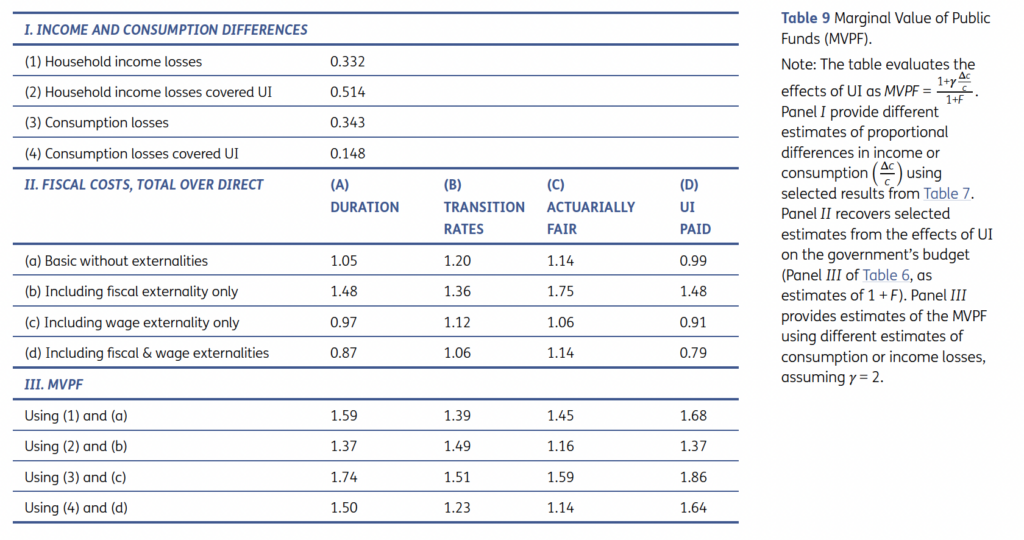
- (A) Average durations: Net cost per peso transferred = 0.87
- (B) Transition rates (from proportional-hazard models): Net cost per peso transferred = 1.06
- (C) Actuarially fair budget: Net cost per peso transferred = 1.14
- (D) Total UI paid per spell: Net cost per peso transferred = 0.79
(A) works with average durations and the linear RKD elasticities. (B) rewrites the same budget in terms of transition rates, taking the responses of the UI exit rate and the job-finding rate from proportional-hazard models. (C) imposes an actuarially fair budget in which total time is fixed, so a longer non-employment spell mechanically eats into time spent employed and the non-employment response matters even without other government spending. (D) replaces the separate duration responses with the single elasticity of total UI paid, 0.99, which bundles the mechanical peso and the behavioral response together.
Willingness to Pay
The willingness to pay for $1 of additional UI benefits is estimated as
where γ is the coefficient of relative risk aversion, set to 2, and Δc/c is the proportional gap in consumption between the employed and UI beneficiaries.
The paper’s preferred input for Δc/c is the gap for household heads receiving UI: per equivalent adult, non-durable household consumption is 14.8 percent lower for a household head collecting UI or other public transfers than for a formally employed head, from the ENGHO 2004–05 cross-section with demographic controls. This yields a willingness to pay estimate of 1.296.
The paper measures the drop at job loss several ways.
- On the consumption side, the ENGHO cross-section puts consumption 36 percent lower for the unemployed generally and 23 percent lower for those out of the labor force, against 24 percent for the informally employed and 7 percent for the self-employed. Restricting to the unemployed who had labor income in the previous six months gives 34 percent, and it is within that group that heads receiving UI show the 14.8 percent gap used above. Pooling all non-formal statuses and reweighting them to the mix observed in the first nine months after a formal separation gives 20 percent.
- On the income side, the EPH panel shows household income falling about 33 percent in the quarter after a formal layoff and recovering only mildly, with a fall of 51 percent for households whose head is a UI beneficiary and of about 21 percent where the head takes informal or self-employed work. That informal and self-employment income is an effective consumption-smoothing channel is the paper’s explanation for why the consumption gap is so much smaller than the income gap in this setting.
MVPF Summary
Dividing a willingness to pay of 1.296 by each of the four net cost estimates gives the paper’s preferred estimates:
- (A) Average durations: MVPF = 1.50
- (B) Transition rates: MVPF = 1.23
- (C) Actuarially fair: MVPF = 1.14
- (D) Total UI paid: MVPF = 1.64
The average of these four is 1.38.
The paper also reports alternative MVPF estimates built from alternative cost estimates (including or excluding the fiscal and wage externalities) paired with alternative measures of willingness to pay (changes in household income after separation from a formal job, household income losses counting only households with a worker receiving UI, and consumption losses after separation). These alternative MVPF estimates are summarized in Table 9 (the last row of which documents the MVPFs noted above):
References
Herrera, Joaquín, Martin Gonzalez-Rozada, and Hernán Ruffo (2026). “The Fiscal Costs of Unemployment Insurance.” Economía LACEA Journal, 25(1): 15–39. https://doi.org/10.31389/eco.533
Schmieder, Johannes F., and Till von Wachter (2016). “The Effects of Unemployment Insurance Benefits: New Evidence and Interpretation.” Annual Review of Economics, 8: 547–581. https://doi.org/10.1146/annurev-economics-080614-115758
Policy Features
- Category
- Social Insurance
- Sub-Category
- Unemp. Ins.
- Beneficiary Type(s)
- Adults
- Average Age
- 35
- Average Income
- $1,186.45 per month
- Country of Implementation
- Argentina
- Year of Implementation
- 2005-2007
- Empirical Method
- Regression Discontinuity
- Research Type
- Primary
- Peer Reviewed
- Yes
- MVPF Publication Link
- doi.org/10.31389/eco.533