
Marginal Returns to Public Universities
Introduction
Mountjoy (2026) studies the returns to enrolling in U.S. public universities by comparing the long-term outcomes of barely admitted versus barely rejected applicants. The paper uses administrative admission records spanning all 35 public universities in Texas, which collectively enroll 10% of all American public university students, to systematically identify and employ decentralized cutoffs in SAT/ACT scores that generate discontinuities in admission and enrollment.
Pays for Itself
Net Cost
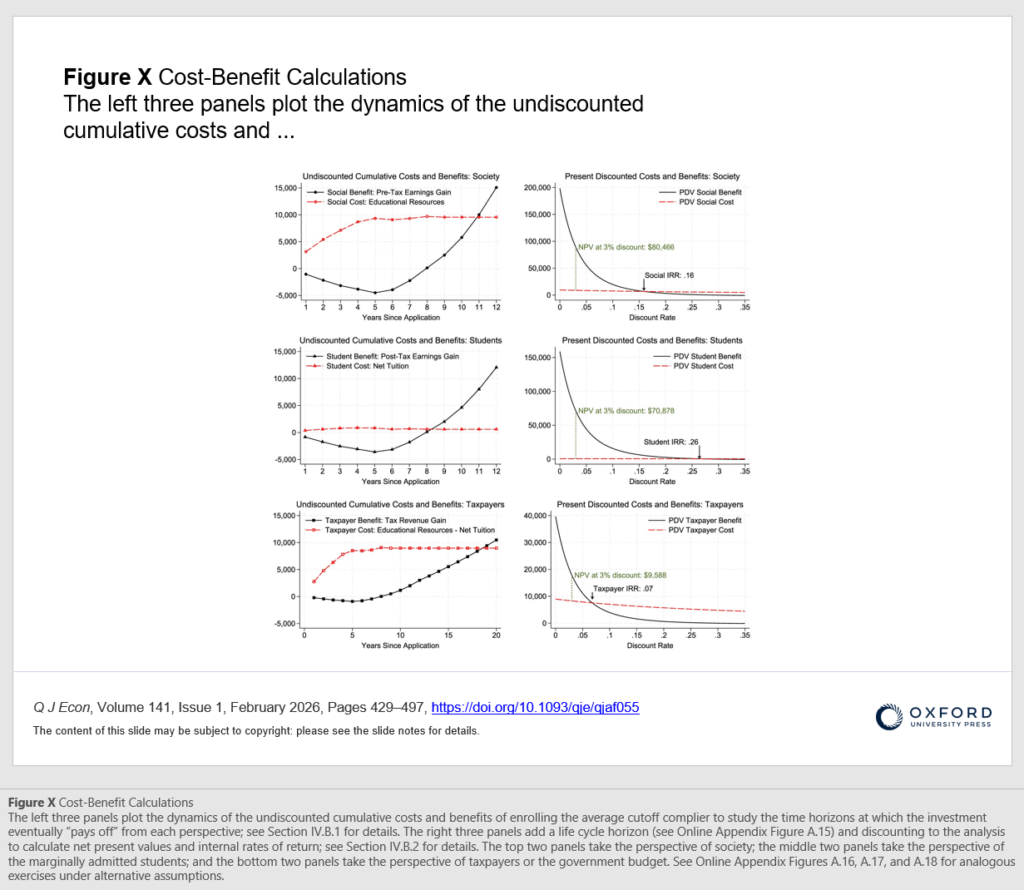
The paper includes two components in the net cost calculation: (1) estimates of the impact of marginal admission to a public university on the cumulative amount of incremental education subsidies the government pays for the average student induced to enroll and (2) the corresponding impact on the cumulative tax revenue generated from the student’s additional earnings. The difference between these, discounting the future flows at a rate of 3%, yields a net present value of $9,588 of positive net revenue generated, i.e. a negative -$9,588 net cost to the government per student induced to enroll.
Willingness to Pay
The willingness to pay is the impact of marginal admission to a public university on the cumulative additional gross earnings of the average student induced to enroll less the additional net tuition paid by the student and a 20% tax rate on the additional gross earnings. Discounting the future flows at a rate of 3% yields a net present value of $70,878 of net private benefits to the average student induced to enroll.
MVPF Summary
As the average marginally admitted student eventually generates more tax revenue than the government’s cost of subsidizing the education (for all discount rates below 7%), the marginal admission pays for itself, and the MVPF is infinite.
References
Mountjoy, Jack (2026). “Marginal Returns to Public Universities.” The Quarterly Journal of Economics, 141(1): 429-497. DOI: https://doi.org/10.1093/qje/qjaf055
Policy Features
- Category
- Education
- Sub-Category
- College Adult
- Beneficiary Type(s)
- Adults, Children and Youth, College enrollees, Students
- Average Age
- 18
- Average Income
- 44000
- Country of Implementation
- United States
- Year of Implementation
- 2004-2014
- Empirical Method
- Regression Discontinuity
- Research Type
- Primary
- Peer Reviewed
- Yes
- MVPF Publication Link
- doi.org/10.1093/qje/qjaf055