
Free and Reduced-Price Public Transportation Fares
Introduction
Chizeck and Mbonu (2026) study the effect of public transportation fare discounts for low-income adults using an RCT that was conducted in Allegheny County, Pennsylvania (Pittsburgh). Study enrollment took place on a rolling basis between November 2022 and February 2023. The sample consists of 9,544 working-age adults who were receiving Supplemental Nutrition Assistance Program (SNAP) benefits at the time they enrolled. Each enrollee was randomly assigned with equal probability to receive one of three fare discount levels on Pittsburgh Regional Transit (PRT): 1) Free fares on all PRT trips 2) A 50% discount on all PRT trips 3) No discount. The discounts lasted for 16 to 19 months and were administered via specially-programmed farecards given to each participant.
Using an intent-to-treat framework, the analysis compares the labor market outcomes of participants assigned to each arm to estimate the treatment effect of half fares and free fares relative to status quo fares. Regression covariates are included to improve the precision of the estimates. Labor market outcomes are measured using Pennsylvania unemployment insurance (UI) quarterly earnings records for up to 8 quarters after random assignment.
For the full sample, the paper finds negligible effects of free fares and half fares on employment and earnings measured cumulatively over the first 8 quarters. However, the paper finds positive and statistically significant effects of free fares on these outcomes among the subgroup that reported being unemployed in the baseline survey.
The MVPF calculation focuses on the free fares treatment for this subgroup (i.e. the “baseline-unemployed”). The calculation assumes that the free-fares policy lasts for 18 months. The costs and benefits of the policy are measured over the first two years from the start of the policy. One version of the MVPF calculation measures willingness to pay (WTP) by revealed preference, while another version measures WTP by the ex post benefits of the policy. All dollar values are deflated to November 2022 levels using the CPI-U.
Pays for Itself
Net Cost
The paper estimates the net cost per person as (1) the direct cost of the fare subsidy, (2) savings from increased income tax revenues, (3) a net increase in expenditures on UI benefits, and (4) a net increase in combined expenditures on various public assistance programs.
(1) Direct cost of free transit fares for 18 months
The direct cost of free fares to the government includes foregone fare revenue, administrative costs, and any marginal costs of additional ridership on PRT operating expenses.
Free fares cause PRT to lose the fare revenue ($2.75 per trip) that it would otherwise earn under regular prices. The additional ridership induced by free fares does not count towards foregone revenue because this ridership does not exist under the counterfactual of regular prices. The baseline-unemployed control group members took an average of 1.98 payable PRT trips per week (excluding free transfers) according to the paper’s preferred measure of transit ridership. This amounts to 1.98 * 52 * 1.5 = 154.44 trips over 18 months. The policy thus cost PRT 154.44 * $2.75 = $424.71 in foregone fare revenue per person.
The local government agency that implemented the RCT hired one part-time employee to manage the fare discount program. This person worked 25 hours per week at $25 per hour, for a total 18-month administrative cost per participant of (25 * $25 * 52 * 1.5) / 9,544 = $5.11.
The paper assumes that PRT incurs no marginal expense to serve an additional passenger.
Summing these costs yields a total direct cost of $424.71 + $5.11 = $429.82 per person.
(2) Savings from increased tax revenues
Savings from increased income tax revenue is estimated as:
where \tau^{INC} is set to 13.07% to reflect a flat Pennsylvania state income tax of 3.07% and a combined marginal federal income tax of 10%, and \tau^{PAY} is a flat employee payroll tax rate of 7.65%. The paper uses a quarterly discount rate of 1% and \hat{\beta}^{t, earnings} is the treatment effect of free fares on earnings in each quarter. This revenue leads to savings of $782.61 per participant.
(3) Net increase in expenditures on UI benefits
The per-person fiscal impact on UI benefit payments in the first 8 quarters is estimated as:
where \tau^{UI} is set to 10% to reflect a combined marginal federal income tax of 10%, as UI benefits in Pennsylvania are subject to federal income tax but not state or local taxes. \hat{\beta}^{t, UIbenefits} is the treatment effect on the amount of UI benefits received in each quarter. The result is an increase in UI benefits payments of $47.79.
(4) Net increase in combined expenditures on various public assistance programs
The per-person fiscal impact on public assistance payments in the first 24 months is estimated as:
where\hat{\beta}^{t, P(benefit)} is the treatment effect on the likelihood of receiving the given public benefit in the month. The average monthly benefit expenditures per person are based on estimates from prior literature or available program documentation (Medicaid is from Kaiser Family Foundation (2025); SNAP is from U.S. Department of Agriculture (2025); TANF is the maximum benefit amount for a family of 3 in Pennsylvania; SSI is from Social Security Administration (2025).; Section 8 is based on the average cost of a Housing Choice Voucher (i.e. Section 8 voucher) to the Allegheny County government in 2024 according to the authors’ analysis of local administrative data; Child care subsidies are calculated using data from Office of Child Care (2025a) and Office of Child Care (2025b)) The result is a net increase in combined public assistance expenditures of $269.10.
The total net cost is $429.82 – $782.61 + $47.79 + $269.10 = -$35.90
Willingness to Pay
The paper models the WTP using two separate methods: (1) a revealed-preference approach, and (2) an ex post approach based on the personal benefits derived from free transit fares. Both methods are used because it is unclear whether participants fully understood the benefits of free transit fares and were privately optimizing ex ante. If they fully understood the benefits, then their WTP is based on revealed preference: the number of transit trips they take under free fares. If they initially misjudged the benefits of free fares, then it may be more appropriate to use an ex post valuation of WTP based on any downstream benefits the person derives from the subsidy.
(1) Revealed preference approach
The paper abstracts from any insurance value of the fare subsidies for risk-averse individuals. This imposes an upper bound valuation of $1 per dollar of subsidy. In fact, the average baseline-unemployed participant valued the subsidy at less than its resource cost, as shown by the following demand curve that is traced out by the three fare prices that were tested in the RCT:
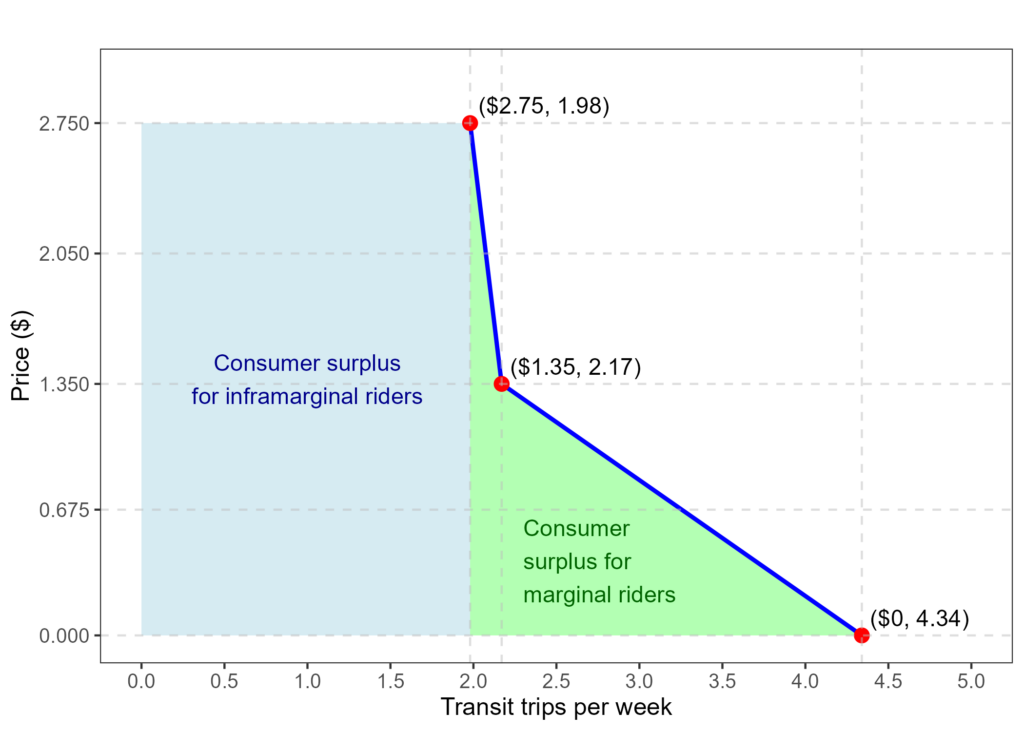
The demand curve linearly interpolates between the three observed price effects. Free fares provide consumer surplus of 1.98 * $2.75 = $5.45 for the 1.98 payable weekly trips that the person would take under regular prices, 0.19 * $2.05 = $0.39 for the 0.19 additional payable weekly trips induced when fares decrease by half to $1.35, and 2.17 * $0.675 = $1.46 for the 2.17 additional payable weekly trips induced when fares become free, for a total WTP of ($5.45 + $0.39 + $1.46) * 52 * 1.5 = $569.34 per person over the 18-month subsidy period.
(2) Ex post benefits approach
The paper models the ex post WTP as earnings gains adjusted for the disutility of labor, as well as the increased receipt of UI benefits and other transfers.
The earnings component of WTP is estimated as:
The parameter z is the adjustment for the disutility of labor and is taken to be 0.6 as estimated in Mas and Pallais (2019). As above, \tau^{INC} is set to 13.07% to reflect a flat Pennsylvania state income tax of 3.07% and a combined marginal federal income tax of 10%, and \tau^{PAY} is a flat employee payroll tax rate of 7.65%. The quarterly discount rate is 1% and \hat{\beta}^{t, earnings} is the treatment effect of free fares on earnings in each quarter. The result is a WTP for increased earnings of $2,101.46.
The UI benefits component of WTP is estimated as:
where \tau^{UI} is set to 10% to reflect a combined marginal federal income tax of 10%, and \hat{\beta}^{t, UIbenefits} is the treatment effect on the amount of UI benefits received in each quarter. The result is a WTP for increased UI benefits of $47.79.
The public assistance component of WTP is estimated as:
where \hat{\beta}^{t, P(benefit)} is the treatment effect on the likelihood of receiving the given public benefit in the month. The average monthly benefit amounts per person are based on estimates from prior literature or available program documentation (SNAP, TANF, SSI, and child care subsidies are based on the same monetary valuations as in the Net Cost calculation above. Medicaid is based on the average monthly out-of-pocket health care spending per capita in the U.S. among people age 19 to 64 in 2020 from Centers for Medicare and Medicaid Services (2025); Section 8 is based on the average cost of a Housing Choice Voucher (i.e. Section 8 voucher) to the Allegheny County government in 2024 according to the authors’ analysis of local administrative data. The paper follows Hendren and Sprung-Keyser (2020) in taking a WTP estimate from Reeder (1985), whose estimates suggest recipients are willing to pay 83% of the cost of the voucher.) The result is a WTP of $262.76 for the net increase in public assistance payments.
The total WTP using the ex post valuation approach is $2,412.01 per person.
MVPF Summary
The paper estimates a positive willingness-to-pay and a negative government cost, yielding an infinite MVPF estimate for 18 months’ worth of free public transportation fares for unemployed SNAP adults.
References
Centers for Medicare and Medicaid Services (2025). “National Health Expenditure Data-Historical.” https://www.cms.gov/data-research/statistics-trends-and-reports/national-health-expenditure-data/historical.
Chizeck, Seth and Oluchi Mbonu (2025). “Faring Well in the Labor Market: The Employment Effects of Public Transportation Fare Subsidies.” Working Paper. https://github.com/sethchizeck/papers-by-seth-chizeck/blob/main/Faring%20Well%20in%20the%20Labor%20Market%3B%20The%20Employment%20Effects%20of%20Public%20Transportation%20Fare%20Subsidies.pdf
Hendren, Nathaniel and Ben Sprung-Keyser (2020). “A Unified Welfare Analysis of Government Policies.” The Quarterly Journal of Economics, 135(3): 1209–1318. DOI: https://doi.org/10.1093/qje/qjaa006
Kaiser Family Foundation (2025). “Medicaid Spending per Enrollee (Full or Partial Benefit) by Enrollment Group, 2021.” https://www.kff.org/medicaid/state- indicator/medicaid-spending-per-enrollee.
Mas, Alexandre and Amanda Pallais (2019). “Labor Supply and the Value of the Non-Work Time: Experimental Estimates from the Field.” American Economic Review: Insights, 1: 111-126. DOI: https://doi.org/10.1257/aeri.20180070
Office of Child Care (2025a). “CCDF Expenditures Overview for FY 2021 (all appropriation years).” U.S. Department of Health and Human Services, Administration for Children and Families. https://acf.gov/occ/data/ccdf-expenditures-overview-fy-2021-all-appropriation-years.
Office of Child Care (2025b). “FY 2021 Final Data Table 1 – Average Monthly Adjusted Number of Families and Children Served.” U.S. Department of Health and Human Services, Administration for Children and Families. https://acf.gov/occ/data/fy-2021-final-data-table-1.
Reeder, W.J. (1985). “The Benefits and Costs of the Section 8 Existing Housing Program.” Journal of Public Economics, 26(3), 349-377. DOI: https://doi.org/10.1016/0047-2727(85)90014-3
Social Security Administration (2025). “Annual Statistical Supplement, 2023.” https://www.ssa.gov/policy/docs/statcomps/supplement/2023/ssi.html.
U.S. Department of Agriculture (2025). “SNAP state factsheet – Pennsylvania.” https://fns-prod.azureedge.us/sites/default/files/resource-files/snap-state-factsheet-pa.pdf.
Policy Features
- Category
- In Kind Transfers
- Sub-Category
- Local Taxes/Subsidies
- Beneficiary Type(s)
- Adults
- Average Age
- 39.5
- Average Income
- 9032 per year
- Country of Implementation
- United States
- Year of Implementation
- 2022
- Empirical Method
- RCT
- Research Type
- Primary
- Peer Reviewed
- No